Hand tools are not products that go out to the field for repair — they are products customers bring in, leave at the service centre, and have passed through the hands of multiple technicians before they are returned. This structure both simplifies and complicates service tracking: the product stays put, but the responsible person keeps changing.
FieldCo has been the preferred choice in the hand tools sector for many years. Behind this preference is not only a feature set, but a deliberately simple interface built around the sector's operational realities.
---
What Gets Recorded at Intake?
When a customer brings in a product, the service agent registers it in the system. At this point, more than just a fault description is entered — everything that will affect the full service journey is captured:
- Accessories: All items accompanying the product — charger, carrying case, warranty card — are logged. This prevents disputes at return ("there was no box" or "we never got the box").
- Product damage condition: Any physical damage present at intake is noted. Scratches, cracks, or missing parts are recorded; a photo can be attached to the work order.
- Incoming waybill number: If the product was shipped in, the waybill number is added to the record.
- Incoming tracking number: The courier tracking number is linked to the work order so the question "Did my product arrive?" is answered by looking at the system, not making a call.
---
Station Transitions: Who Did What?
At the heart of hand tools service lies this question: Who currently has this product, and at what stage?
The FieldCo mobile app answers this question at every station transition.
#
1. The Technician Claims the Job
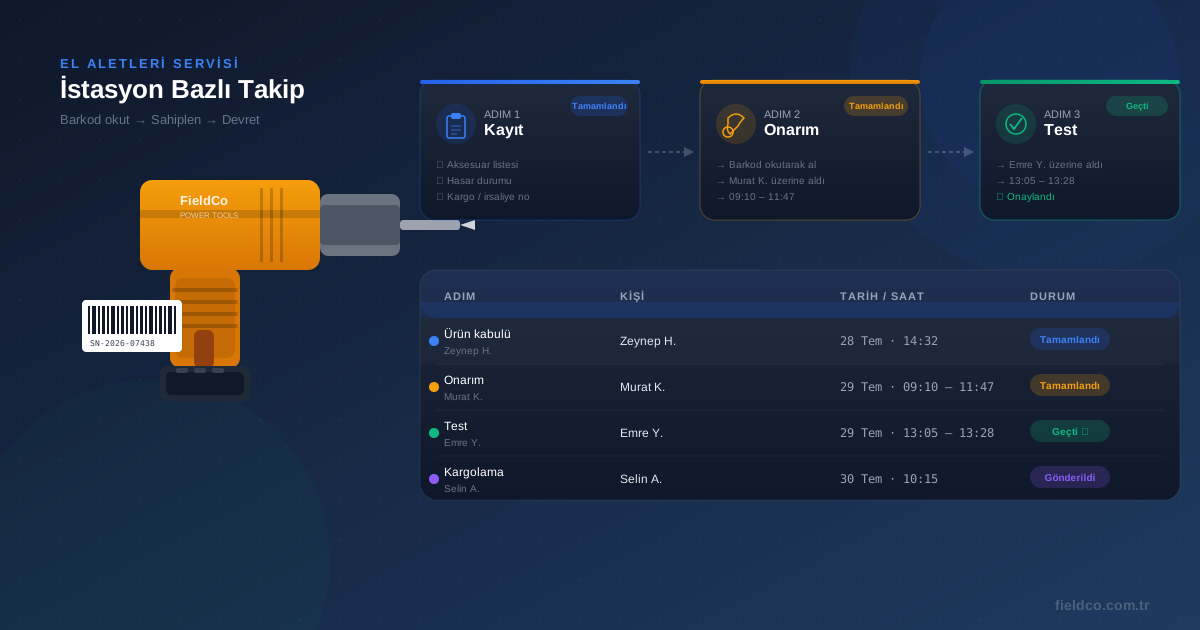
The barcode or QR label affixed to the product is that product's identity. Before starting a repair, the technician scans the label in the mobile app to take ownership of the work order.
The system records: *"This work order was picked up by [technician name] at [time]."*
Responsibility is now clear. When the repair is done, the technician closes the step — and the product is ready for the next station.
#
2. Test Handled by a Different Person? No Problem
In many hand tools service centres, repair and testing are separate tasks. A different technician runs the test after the repair is done. That technician simply scans the same label to claim the test step.
The system records: *"Test step started by [technician name] at [time]."*
#
3. Shipping Is Tracked Too
When the product is to be returned to the customer by courier, the same flow applies at the shipping step. The person packing the shipment scans the label to claim the step, and the outbound tracking number is entered into the work order at this point.
---
Log Records: Who, When, and at Which Step?
Every barcode scan creates a log entry. When a service manager opens a work order, they see:
| Step | Person | Date / Time |
|------|--------|-------------|
| Product intake | Sarah H. | 28 Jul 14:32 |
| Repair started | Mark K. | 29 Jul 09:10 |
| Repair completed | Mark K. | 29 Jul 11:47 |
| Test started | James Y. | 29 Jul 13:05 |
| Test completed | James Y. | 29 Jul 13:28 |
| Shipped | Lisa A. | 30 Jul 10:15 |
Looking at this table, the answer to "why did the product sit for two days?" is already visible: the repair closed at 11:47, but the test didn't start until 13:05. That gap clearly shows where the backlog formed.
---
Why Is FieldCo Preferred for Hand Tools?
Hand tools service centres typically run high-volume, fast-cycle operations. Dozens of products may be checked in on a single day; the technical team works at pace and does not want to spend time navigating complex interfaces.
The key reasons FieldCo is chosen in this sector:
Simple interface: A technician who can see at a glance what to do on a given screen adapts to the system without training. Menus are short, flows are direct.
Mobile-first design: No computer at the workbench is needed. All station transitions can be completed from a phone or tablet.
Barcode scan speed: Scan the label, confirm, continue. Three steps. No typing a work order number, no searching for a product.
Multi-station architecture: Repair, testing, quality control, shipping — each step is tracked independently. Multiple people taking different roles on the same work order is a natural part of how the system works.
---
Summary
The biggest risk in hand tools service is not knowing where a product is, and having to investigate after the fact to find out who took which step.
FieldCo records every barcode scan as a transfer of responsibility. This makes the service process transparent, log records traceable, and backlogs visible in real time.
Because it is easy to use, the technician adopts the system as a natural part of their workflow — not as an extra tool to manage.
Explore FieldCo features and pricing →