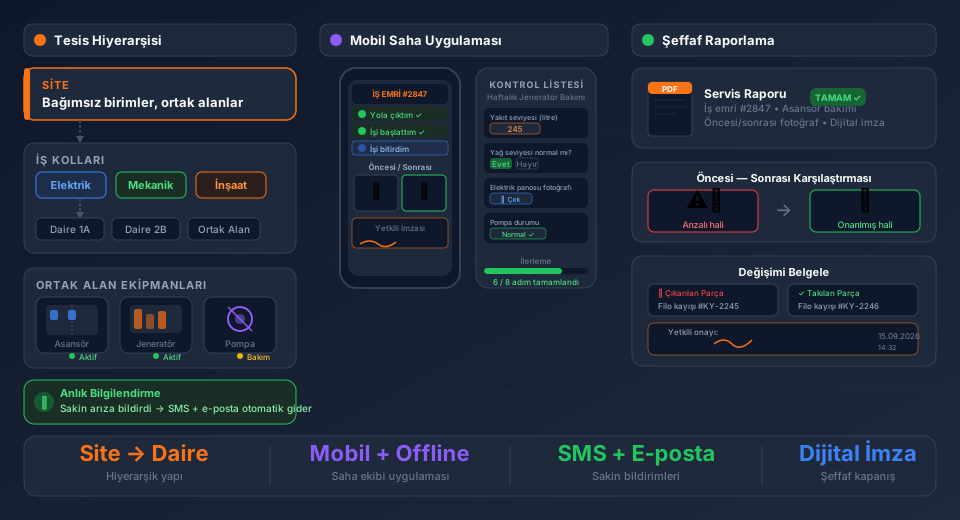
Reactive vs. Planned: The Fundamental Choice in Facility Management
There are two basic approaches in facility management:
Reactive maintenance: Intervene when a fault occurs. Costs look low but outcomes are expensive: production stops, emergency responses cost extra, and a small maintenance lapse can escalate into major damage.
Planned (preventive) maintenance: Regular inspections and maintenance before failures happen. While the upfront cost appears higher, total cost of ownership (TCO) drops significantly.
Research shows that facilities switching to planned maintenance experience 25-40% fewer downtime incidents on average compared to reactive maintenance.
---
What is CMMS and How Does it Differ from FSM?
CMMS (Computerized Maintenance Management System) is software used to manage the maintenance processes of facility assets. Equipment within buildings — elevators, compressors, generators, HVAC, electrical panels — is linked to planned maintenance schedules with CMMS.
FSM (Field Service Management) focuses on managing field teams: work order assignment, mobile app, customer notifications.
FieldCo combines both concepts: planned maintenance scheduling for facility assets and field team coordination run on the same platform.
---
Digital Work Order Flow in Facility Management
#
Fault Reporting
When internal facility personnel (security staff, production operators, cleaning crew) notice a fault:
- They file a photo-accompanied fault report from the mobile app.
- The system automatically creates a work order.
- The facility manager receives an instant notification.
- The relevant technician is assigned within seconds.
"I told someone but no one came" becomes a thing of the past.
#
Planned Maintenance Schedule
A maintenance plan is defined for each piece of equipment:
- Elevator: Monthly mechanical inspection, annual license examination
- Compressor: Oil change every 500 hours
- Generator: Quarterly test run and fuel check
- HVAC: Season-start filter cleaning and gas check
When the date arrives, a work order opens automatically and the technician receives a notification. No maintenance ever falls through the cracks.
#
Asset Management
A digital card is created for each piece of equipment:
- Brand, model, serial number
- Purchase date, warranty status
- Full maintenance and fault history
- Total maintenance cost (what has been spent)
- Estimated useful life and replacement planning
This data supports management decisions about when to invest in which equipment.
---
Multi-Floor Building and Campus Management
Managing equipment distributed across different buildings and floors can be extremely complex to plan, even for smaller facilities. The digital system:
- Tags equipment by location (building, floor, room).
- Filters work orders by location.
- Assigns the nearest technician to the area.
- Provides fault reports by floor/building.
---
Integration with Manufacturers like Fobem and Skytech
For service teams visiting facilities under maintenance contracts from the manufacturer side, the equipment list at the customer facility is imported into the system. During each visit:
- Which maintenance was performed on which equipment is documented.
- The customer gives digital approval.
- The maintenance report is automatically archived.
This ensures complete documentation for both the customer and the service company.
---
Concrete Results
Facility managers running planned maintenance programs with FSM software report on average:
- 30-45% reduction in unexpected fault incidents
- 25% decrease in emergency response costs
- 15-20% extension in equipment lifespan
- 60% savings in manager reporting time
---
Conclusion
Without planned maintenance, facility management degenerates into reactive crisis management. FieldCo — combining CMMS functionality with FSM — enables facilities to manage both their assets and their teams efficiently from a single platform.
Planned maintenance and work order management with FSM software →
MÇ
Metin Çelik
Founder & CEO — FieldCo / MOBIM Software
Metin Çelik founded MOBIM Software in 2002 and has spent 24 years in field service management, helping 350+ companies digitalise their field operations.