Why Customer Satisfaction is Critical in Field Service
Field service makes contact with customers during a difficult moment — when their device is broken, when their operations are halted. That moment is both a major source of frustration and an opportunity to build lasting trust.
Research shows that customers satisfied with a technical service experience are 70% more likely to repurchase from the same brand. Conversely, a single bad service experience is enough to send a customer to a competitor.
---
1. Appointment Confirmation and Reminders
"The technician will arrive sometime in the afternoon" is consistently among the top customer complaints. Clear, timed appointment notifications solve this problem at the root.
How to implement:
- When a work order is created, the customer is notified of the appointment date and time via SMS or email.
- A reminder is sent one day before the service date.
- When the technician sets off, a "Your technician is on the way" notification triggers automatically.
These three steps reduce "when is someone coming?" calls on service day to nearly zero.
---
2. Sharing Technician Information
Customers want to know who will be at their door. Especially for home visits, this is critical for security and trust.
On the day of service, a notification containing the technician's name — and optionally a photo — can be sent to the customer. This small detail measurably increases customer confidence.
---
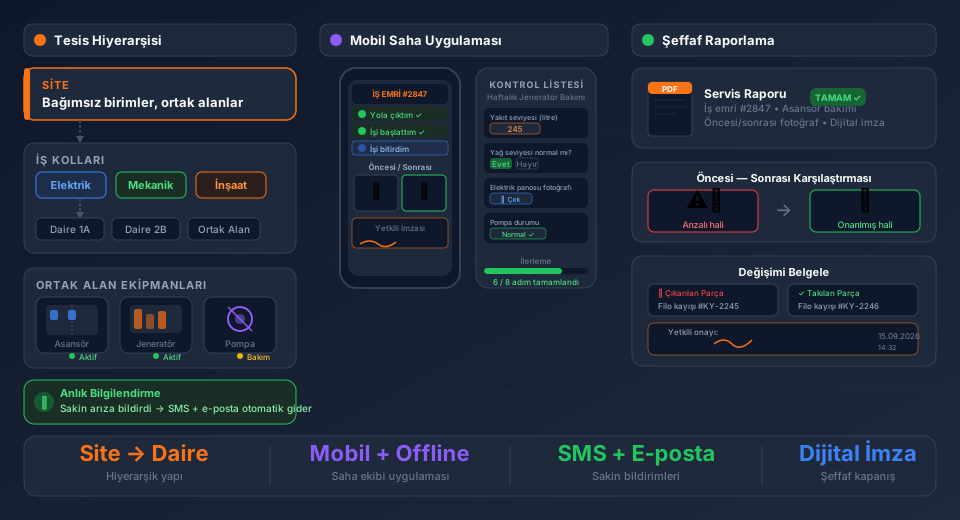
3. Digital Service Report and Approval
Paper-signed, handwritten service forms get lost, become illegible, and leave no lasting impression with customers. A digital service report:
- Clearly lists work performed, parts used, and technician notes.
- The customer approves with an SMS code or on-screen signature.
- Is instantly sent as a PDF to the customer's email.
- Can be re-downloaded from the customer portal whenever needed.
When customers have documentation, the "I don't know what they did" complaint disappears.
---
4. Real-Time Status Updates
Via customer portal or SMS notification, customers can track every stage of the service process in real time:
- Work order created
- Technician assigned
- Technician on the way
- Service completed
- Report ready
This transparency eliminates the anxiety that comes from uncertainty.
---
5. First-Time Fix Rate
The customer's most basic expectation: the technician comes once and resolves the issue. A second visit is a serious loss in both cost and customer satisfaction.
To improve first-time fix rate:
- Before visiting the customer, the technician must be able to see the device model, likely fault type, and required parts.
- Vehicle stock must be planned correctly in advance.
- Recurring faults must be reported and root cause analysis performed.
In FieldCo, when a technician opens a work order, they see the customer's complete service history for that device. This information significantly increases the likelihood of having the right part in the vehicle and resolving the issue on the first visit.
---
6. Feedback Loop with the Survey Module
After service is completed, a short satisfaction survey is automatically sent to the customer. Data from this survey:
- Enables technician-level performance evaluation.
- Identifies weak points in the process.
- Automates NPS (Net Promoter Score) tracking.
- Serves as an early warning system for negative feedback.
Companies without a feedback loop notice problems only after losing customers. The survey module eliminates that delay.
---
7. Digital Approval and Payment
Requiring customers to come to the office, make a bank transfer, or have cash on hand is cumbersome for both the customer and the service company. With the digital approval and payment module:
- While the technician is on-site, the customer approves the service quote.
- A payment link is sent via SMS.
- The customer pays instantly by credit card or bank transfer.
- Payment status automatically reflects in the work order.
This flow shortens collection time and improves cash flow.
---
Conclusion
Customer satisfaction starts with the technician's technical competence — but continues through the process experience. Timely notifications, transparency, digital documentation, and a fast feedback loop: when these seven elements come together, a field service operation produces an experience that converts into customer loyalty.
How field service management software improves customer experience →
MÇ
Metin Çelik
Founder & CEO — FieldCo / MOBIM Software
Metin Çelik founded MOBIM Software in 2002 and has spent 24 years in field service management, helping 350+ companies digitalise their field operations.